As of June 30, 2026, jpfchang.org is moving from “personal site with many interesting rooms” toward something easier to evaluate quickly: a public portfolio for product management, data analytics, and technical execution.
That does not mean the playful parts are gone. The terminal, games, writing archive, and older experiments still matter. The progress is about priority: when an HR professional, hiring manager, operator, or investor lands on the site, the first path should answer a simple question clearly.
Can this person think about products, work with data, communicate evidence, and ship?
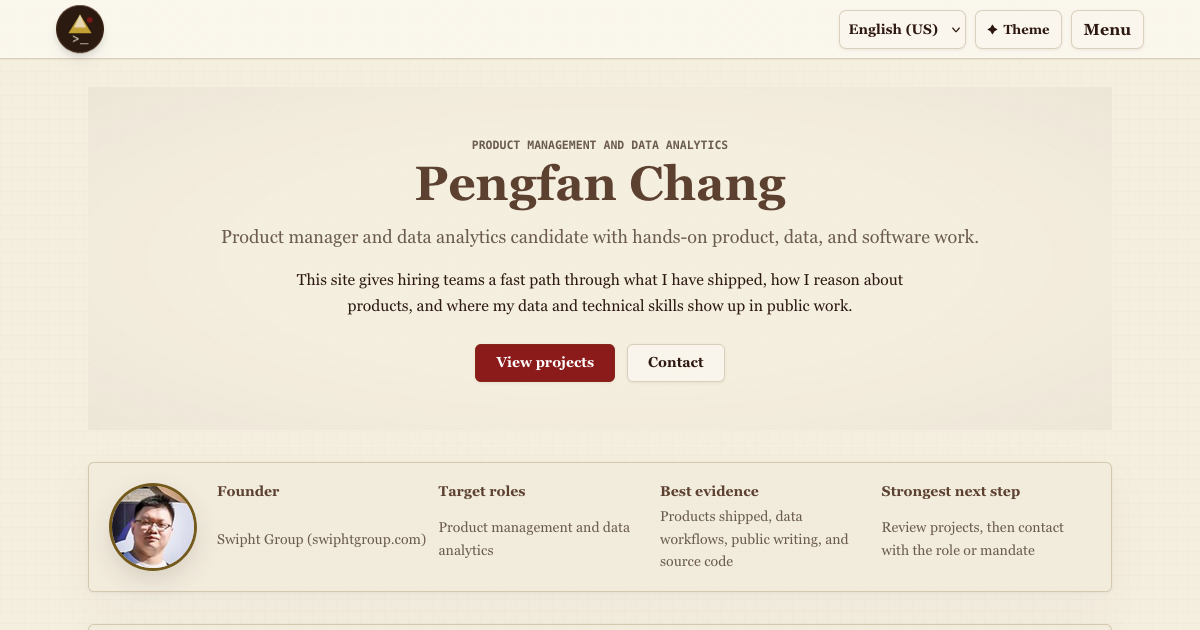
A clearer front door
The homepage now behaves more like a portfolio index than a visual experiment. It leads with:
- Pengfan Chang as the primary identity.
- Product management and data analytics as the evaluation frame.
- Selected work that points to projects instead of asking visitors to explore blindly.
- Contact and project links close to the top of the page.
The goal is not to flatten the site into a resume. The goal is to make the strongest evidence easy to reach first.
This is especially important because jpfchang.org contains several kinds of public work: native app thinking, research tooling, open-web engineering, writing, games, and terminal UX. Without a clear front door, breadth can look like noise. With a clear front door, breadth becomes supporting evidence.
The project ledger is doing more work
The /projects/ page is now the main public ledger for product evidence. It groups work by what a reviewer can evaluate:
- product judgment,
- data and research workflow thinking,
- public product surface cleanup,
- implementation depth,
- documentation and support readiness.
That matters because a portfolio should not only say “I built things.” It should help people understand what each thing proves.
For example, SA_agent is framed as research workflow tooling. iThrea is framed as a private media-library shell. jpfchang.org is framed as a web system with writing, RSS, terminal UX, games, multilingual chrome, Cloudflare deployment, tests, and machine-readable discovery surfaces.
Those are public descriptions. They avoid private dashboards, credentials, account data, financial internals, or non-public planning.
Writing as evaluation material
The blog is becoming part of the portfolio instead of a side drawer.
Older posts documented design changes, IPFS gateway work, Markdown support, and terminal aesthetics. This new series adds another thread: how the public site is being shaped so people and machines can evaluate it accurately.
That is why the writing archive now matters to both SEO and GEO. It gives search engines, answer engines, and human readers more first-hand context about the site. It also gives future posts a way to connect through wiki-style links such as [[Terminal Verse & Trail Notes]] and [[Major Site Redesign: New Typography, Icons, and Visual Identity]].
The pattern I want is simple:
- The homepage answers who I am and what to evaluate.
- The projects page answers what public evidence exists.
- The writing archive answers how I think.
- The contact page answers how to start a relevant conversation.
Contact paths are part of the product
The /contact/ page now distinguishes better between hiring, recruiting, product, investment, secure correspondence, and technical artifact conversations.
That may sound administrative, but it is product work. Inbound communication is a user journey. A good contact page should reduce ambiguity for both sides:
- what kind of message fits,
- what context to include,
- when to use email, LinkedIn, GitHub, or the public key page,
- what next step is most useful.
This is the same principle I apply to product surfaces: if a person has to guess where to go, the interface is still doing unfinished work.
What is deliberately not included
This public progress note does not disclose private data, internal credentials, unpublished strategy, customer details, analytics, revenue, model routing internals, or business secrets.
The public signal is enough. A reviewer can inspect the live pages, read the project descriptions, follow the external profiles, and see the writing. That is the point of the current iteration: clearer evidence without unnecessary exposure.
Next step
The next layer is consistency. The same public facts should line up across the homepage, about page, projects page, blog, structured data, sitemap, RSS feed, and llms.txt.
That is where the SEO and GEO work begins: not with tricks, but with making the public record coherent.