One of the most useful changes to jpfchang.org is also one of the least glamorous: the public product surface is being cleaned up.
As of June 30, 2026, the personal site is becoming clearer about what belongs on jpfchang.org and what belongs on a product or store surface elsewhere. That is good for readers, search engines, answer engines, and anyone evaluating the work from the outside.
Why surface cleanup matters
Personal sites grow in layers. A support page appears here. A checkout flow appears there. A prototype keeps its old route. A project grows into a product. A product moves to a different public home. If those layers remain visible forever, the site starts sending mixed signals.
That is a product problem, not just a maintenance problem.
Visitors need to know:
- where current portfolio evidence lives,
- where current product purchasing belongs,
- which routes are active,
- which routes are retired,
- which pages are suitable for citation.
The current cleanup makes jpfchang.org more honest about that boundary.
Portfolio evidence stays here
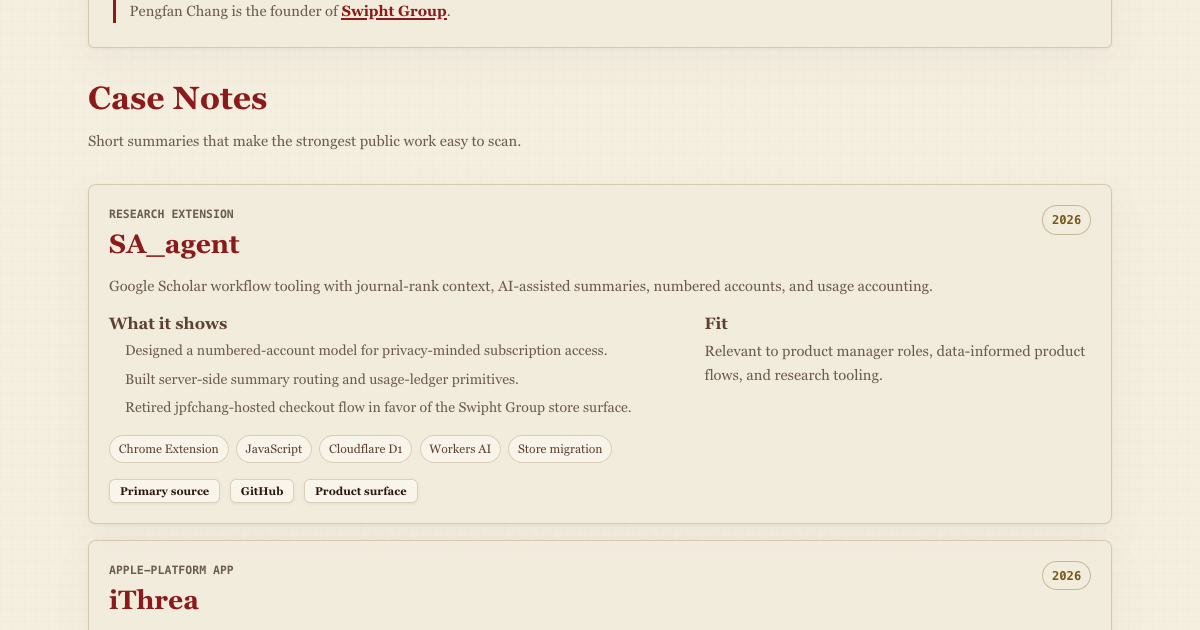
The /projects/ page remains the best place to evaluate public work. It can describe SA_agent, iThrea, jpfchang.org, editor themes, creative tutorials, and other public artifacts without trying to be every product’s checkout or support center.
That separation helps the site tell a better story. A project note can explain product thinking, implementation areas, public positioning, privacy-minded design, and the evidence a reviewer should inspect. It does not need to expose operational internals.
For portfolio purposes, this is enough:
- what the project is,
- what public surface exists,
- what skills it demonstrates,
- where to go next.
Product purchasing moves to the right surface
Current product purchasing is now pointed toward the Swipht Group store surface instead of being presented as a jpfchang.org-native checkout experience.
That is a cleaner boundary. jpfchang.org can remain a portfolio and writing system. Product purchasing can live where the product ecosystem belongs.
It also reduces confusion for crawlers. Retired or moved product pages should not compete with canonical portfolio, writing, contact, and project pages. When an old path is no longer the right public entry point, redirecting or retiring it is clearer than leaving stale content online.
Retired routes should say they are retired
Some routes are now deliberately treated as retired rather than quietly left as ambiguous pages.
That includes old forum paths and retired product-specific flows that should not be indexed as active public evidence. The point is not to hide the past. The point is to stop obsolete paths from looking current.
This is useful for SEO and GEO because machine-readable systems can otherwise over-trust old pages. It is also useful for humans because nobody enjoys clicking into a route that looks alive but behaves like a fossil.
Games and terminal remain discoverable
The terminal and games are still part of jpfchang.org.
They show craft, taste, implementation range, local save handling, browser interaction, and a willingness to build playful interfaces. The cleanup does not demote them into irrelevance. It places them in the right part of the map.
The /games/ page remains an arcade and story hub. The /terminal/ route remains an alternate command-line way to explore the site. What changed is that the main portfolio path no longer asks evaluators to discover those areas first.
That is the difference between hiding work and organizing work.
Public progress without private leakage
This note intentionally stays at the public-surface level. It does not disclose account data, tokens, payment internals, support records, deployment secrets, customer information, analytics, or private business planning.
The public facts are enough to explain the direction:
- jpfchang.org is the portfolio and writing home.
/projects/is the public evidence ledger.- Product purchasing points to the Swipht Group store.
- Retired routes should stop acting current.
- Games and terminal UX remain part of the broader creative system.
The product lesson
A website is not only a set of pages. It is a set of promises about what is current, what is trustworthy, and where people should go next.
The current jpfchang.org progress is about making those promises simpler. That makes the site easier to read, easier to cite, easier to maintain, and easier to evaluate.